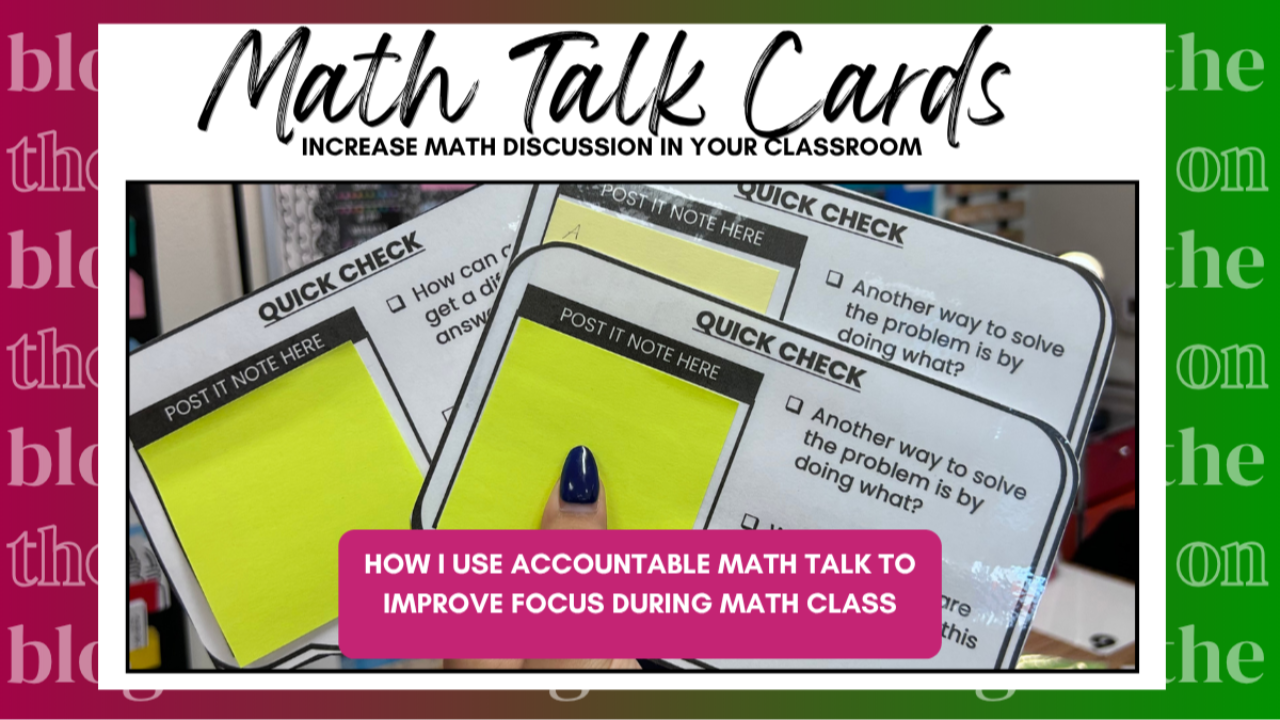
How I Use Accountable Math Talk to Improve Focus During Math Class
Independent work sounds great in theory.
In reality? It often turns into side conversations, half-finished papers, and students who rush through everything just to say they're done. You circulate, redirect, repeat expectations, and somehow still feel like you're managing more than teaching.
Here's the thing. The issue usually isn't the task. It's the lack of accountability for thinking.
This is where Accountable Math Talk changes everything.
What Accountable Math Talk Actually Is — and Isn't
Let's clear this up because there's a lot of confusion around this.
Accountable Math Talk is NOT:
- Calling on random students and hoping for the best
- Running a whole-class discussion every single day
- Cold-calling without giving students any support or language
Accountable Math Talk IS:
- Structured prompts that guide mathematical thinking
- Clear expectations for how students explain their answers
- Students being accountable to ideas — not just correct answers
It gives students the language to talk about math — even during independent or small-group work — so thinking becomes visible without you having to pull it out of them one student at a time.
How I Use Math Talk Cards During Independent Work
I don't save math talk for special lessons or designated discussion days. I built it directly into regular work time, and that's what makes it actually sustainable.
Here's what it looks like in my classroom:
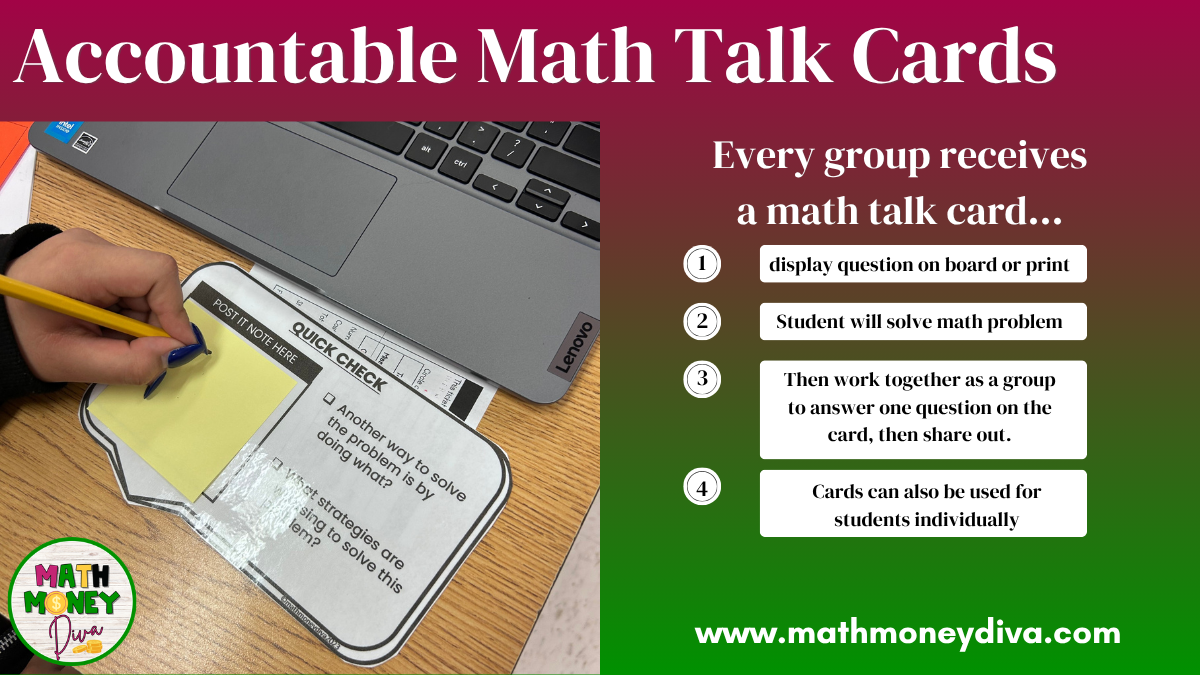
Students work independently or in small groups — the task stays exactly the same, nothing changes there.
Each group gets a Math Talk Card — the card gives students a specific prompt to work with: justify your answer, compare your strategy, explain your thinking, connect this to something you already know.
Students must explain their thinking before moving on — not to me, to each other. Then we share out.
That last part is the key. The card does the prompting, not the teacher. Once that shift happens, you get your time back.
Why Math Talk Cards Keep Students Focused Without Micromanaging
When students know they'll need to explain how they got an answer, justify their strategy, and listen and respond to a peer, they stay engaged longer. Not because you're standing over them, but because the structure expects it.
Math Talk Cards naturally slow down the rushing, reduce off-task behavior, and push students toward real mathematical thinking. Students aren't just working to finish — they're working to understand, because understanding is what they'll be asked to demonstrate.
This pairs especially well with vocabulary-rich lessons where students need language to explain their thinking. Here's how interactive vocabulary activities build the math communication skills students need to talk about math confidently.
What Changed When I Stopped Managing and Started Structuring
Once Accountable Math Talk became a consistent routine in my classroom, things shifted in ways I didn't fully expect.
I talked less during work time. Students relied on each other more. Explanations got stronger. Engagement went up. And the biggest shift of all, accountability stopped depending on me hovering over every group.
The structure held students accountable instead. That's what a good classroom routine does. And math talk works best when it's part of a predictable daily flow students can count on. Here's how agenda slides help build that kind of structure from the moment students walk in.
Why This Works Even in Short Time Blocks
One of the biggest misconceptions about math talk is that it takes too much time. Teachers hear "structured discussion" and immediately picture 20 minutes of whole-class conversation they don't have time for.
That's not what this is.
Even a focused 10-minute window of Accountable Math Talk can deepen understanding, reveal misconceptions you wouldn't have caught otherwise, and improve participation across the board. This is why I use it as a quick built-in routine — not a separate lesson bolted onto an already packed class period.
How to Try This Without Overhauling Your Lesson
You don't need a new curriculum or a complete lesson redesign to make this work. Start here:
- Add one math talk prompt to your next independent work session
- Give students the language to explain their thinking — don't assume they already have it
- Make explanation part of what "being done" actually means in your classroom
Ready-to-Use Math Talk Resources for Middle School
If you want a done-for-you set of math talk prompts and sentence starters that are ready to use tomorrow, my Math Talk Sentence Starters and Prompts for Middle School has everything you need to launch this routine without building it from scratch.
It includes structured prompts for justifying, comparing, explaining, and connecting — all the language middle schoolers need to talk about math with confidence during group discussion and independent work time. And you get to actually teach — instead of spending the whole period managing.
Start with one prompt. Build the routine. Watch what happens.
Don't miss a beat!
For more education tips and valuable information on classroom economy and math teaching resources, join our community!
We hate SPAM. We will never sell your information, for any reason.
Hey Teacher Friend!

